
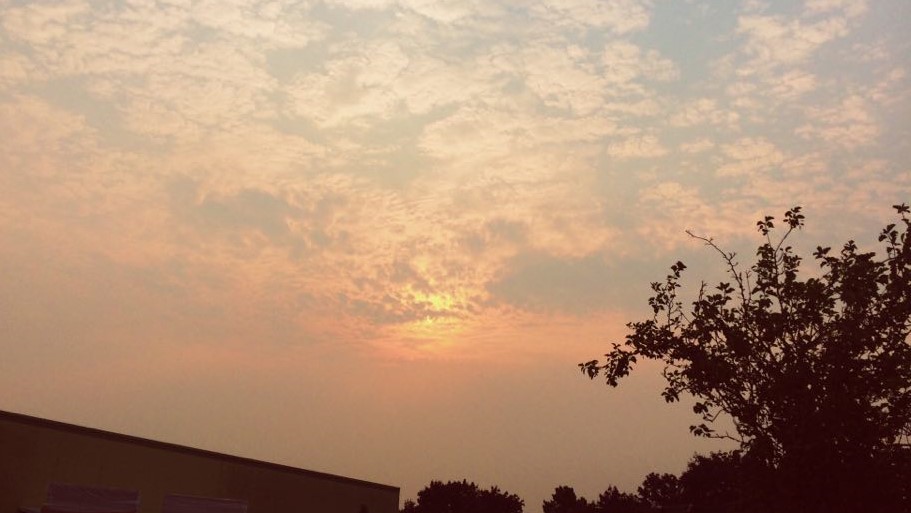
The first day you didn’t notice it so much, didn’t really pay attention. The sky was smoggy, the sun an angry orange, like a neon traffic light. You walked to the grocery store with a sense of uneasiness. A mild dread shivered across your face every time you opened a window.
But that strange Tuesday in September we woke to air thick and bitter with smoke. A man who stepped outside of the Safeway ahead of me burst into a surprised, hacking cough. Ash descended like a light rain, onto the ground, into your hair and eyes. The news warned you not to brush it off the top of your car, lest it scratch the paint, but the temptation was strong. The apocalyptic nature of it felt real, and unreal. I pulled into the driveway to see the neighbor watering her lawn in a surgical mask.
Just seventeen miles away, the gorgeous green head of the Northwest was aflame with an end-of-the-hot-dry-summer, man-caused forest fire. It was shocking in its agression. The headlines were in awe at the sheer agency of it. The fire ‘jumped into Washington.” It ‘tore through’ Oneonta tunnel. The fires ‘ran like vertebrae up the Cascade.’ They ‘raced west acrosss the Gorge.’
That day the scenes in LA were equally apocalyptic. It seemed like the west was on fire.
In moments like these, people will turn to a sort of divine judgment, in whatever form that takes. Either God is angry with us, or the Earth is angry with us, or we are angry with someone else. A teenager who tossed fireworks into the gorge allegedly caused the blaze. Oregonians flocked to Facebook to declare that he should “be behind bars,” or should be forced to work his whole life to replace and repair the damage. This is how it goes. Always judgement finds an obvious target. Sometimes it’s more vague: the government, other people. Sometimes, we look at ourselves.
Why, in the face of tragedy, do we look for someone to scream at, someone to punish?
“Dear friends, do not be surprised at the fiery ordeal that has come on you to test you, as though something strange were happening to you…”
A spark may have started the wildfire, but no one went around lighting each individual tree. That’s where the grief comes from, in part. It comes from the helplessness of the situation. The gut-punch reminder that we have no power, no control over the world around us.
It’s hard for a powerful people to accept a lack of control. It’s hard for a comfortable people to accept the inevitability of suffering. It’s hard to accept that death and change are inescapable. It is hard, and it is humbling.
And yet we accept so much good from the hand of God without a second thought.
That September, my heart had also felt dark and stale and full of smoke. But on Saturday I woke to a breeze so heady and fresh, it felt like spring. The wind had shifted overnight. Inch by inch the fire was being tamed. As the flames receded, we would find that many strong trees withstood the inferno. The Gorge was still green.
Later that day, in the warm September evening, it finally began to rain. Hot, stale houses were thrown wide open to let in the fresh air. The city slept peacefully for the first time in a week.
I could not sleep. In the twilight I stepped outside and turned my head to the blue-grey sky. The rain was falling on my hair, and on the sidewalk, and the air was sweet and sharp and earthy and I swear, when I took a breath, I was filling my lungs with hope.
 L.M. Shearer